Notes on Strategy in a Networked World
January 15, 2025
I recently finished Strategy for a Networked World by Rafael Ramírez and Ulf Mannervik as part of my strategy course at Handelshögskolan. The book brilliantly details how value is no longer created in traditional linear chains, but rather co-created across complex business ecosystems and stakeholder networks.
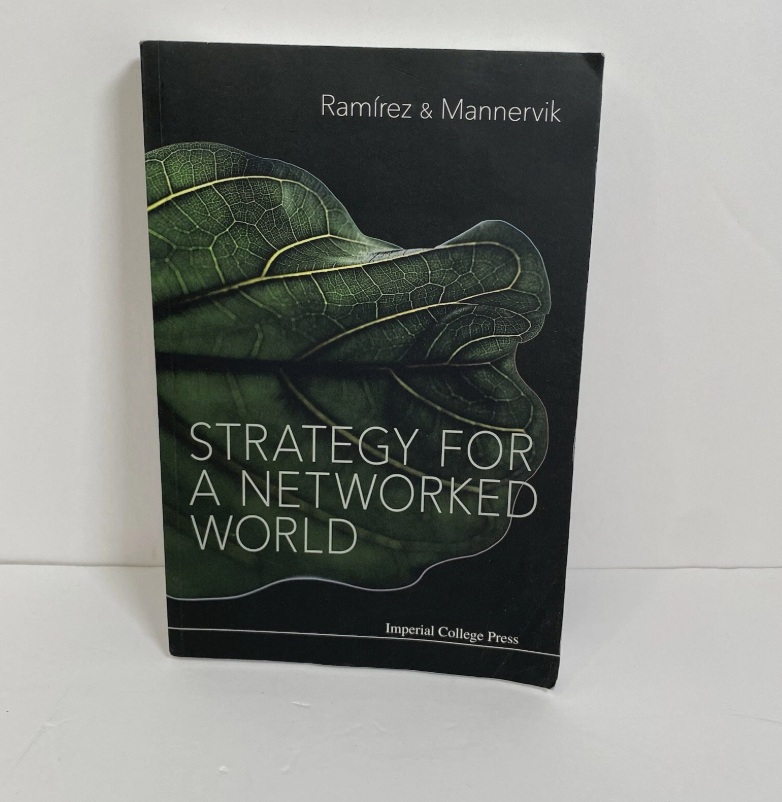
I wrote up my notes to make sure that I had understood the concepts properly. Hopefully, they serve as a helpful refresher if you’ve already read it, or a solid primer if you haven't (highly recommended if 350 pages on strategy sounds like your idea of a good time). I’ve tried to add examples wherever possible. If you disagree with them I’d like to hear it!
You can read more about the book and buy it on amazon.
Part 1:
The Traditional Linear Value Chain:
In the industrial model (e.g Michael Porters famous 'what is a strategy'), value creation works like a factory assembly line.
To see how this works lets take the example of a simple lightbulb:
Step 1: A mining company extracts tungsten, silica, and copper.
Step 2: A factory draws the filament, blows the glass, packages the bulb, and adds manufacturing value.
Step 3: A distributor and a hardware store ship it, stock it, and add retail margin.
Step 4: You buy it at the register for $2.
In classical industrial economics, all value creation has now officially ended. The transaction is the finish line.
Step 5: You screw it into your lamp. Every hour it runs, the filament slowly burns away. Eventually, it burns out completely, its value drops to zero, and you toss it in the bin.
In this setup, value flows in a single direction, sequentially, and the customer’s only role is to pay for and "use up" (destroy) that value.
The Value Creating System (VCS):
In the networked model presented by Ramirez & Mannervik, value creation does not work like a one-way factory assembly line. Instead, it functions like an interactive living web.
To see how this works, let us look at that same lightbulb transformed into a modern, smart lighting ecosystem (such as Philips Hue):
Interaction 1. Platform & Hardware:
A company does not just sell you a glass bulb; it provides an open platform, wireless connected lamps, and software interfaces.
Interaction 2. The Customer as Co-Creator:
You do not simply "consume" or destroy the product. You install the app, program daily automation schedules, set ambient moods, and sync the lights with your routines. By configuring how and when it operates, you actively create the utility and value in use.
Interaction 3. Networked Partners:
Third-party software developers build integrations (e.g., syncing lights with music playlists, video games, or home alarm systems). Motion sensor makers and smart assistants (like Apple HomeKit or Google Assistant) plug into the setup to expand what the system can do.
Interaction 4. Continuous Co-Evolution:
When your energy usage patterns generate anonymized data, the system can optimize electricity consumption during peak grid hours, potentially saving you money and supporting electrical grid sustainability. Firmware updates continuously send new features to your lamp - long after you bought it.
The New Reality:
The purchase is not the finish line, it is merely the invitation to start co-creating. Value does not burn away to zero; it grows, adapts, and is sustained over time through ongoing relationships among the user, software developers, energy providers, and device makers. In this setup, there is no passive "end customer" destroying value at the end of a chain. Value is a dynamic, multi-way dialogue where every participant - including the user/consumer - acts as a value creator.
Part 2:
The Traditional View: The Illusion of Walled-Off 'Industries'
In the industrial strategy paradigm, business is viewed as a gladiator arena enclosed by neat, rigid walls called "industries".
Step 1. The Industry Silo:
You define your company strictly by what you manufacture, such as being in the "Automotive Industry"
Step 2. The Static Battlefield:
You measure your world using traditional industry metrics: vehicle sales, dealership networks, and horsepower. Your rivals are only other car manufacturers (e.g., Volvo competing with Volkswagen).
Step 3. The Zero-Sum Game:
The market is treated as a fixed pie. If you want to grow, your primary strategy is to take a bigger slice by undercutting competitors on price or out-engineering their product features.
Step 4. The Blindspot:
Because your attention is fixed strictly on rivals within your sector wall, you are completely blind to transformations happening outside it.
The Result:
When society's needs shift, your walled-off industry suddenly crumbles, just as camera makers were blindsided not by better cameras - but by mobile phone makers.
Remember Kodak?
The Networked View: Fluid Ecosystems and Strategic Co-Creation
In the Value Creating System (VCS) paradigm, industry walls dissolve into open, interconnected ecosystems where firms constantly balance competing against each other with building the systems they both depend on.
Let us look at how modern mobility, smartphones, and entertainment illustrate this:
Interaction 1. Reframing the Problem-Space:
A company stops defining its competition field by a static product (e.g., "selling cars," "selling phones," or "producing vinyl/CDs") and instead focuses on enabling an ongoing capability (e.g., mobility, personal computing, or instant access to entertainment).
Interaction 2. Cross-Sector Ecosystems:
To deliver that capability, actors from completely different domains must link up. A device maker must connect with telecom carriers, software app developers, payment gateways, and content creators to make the core offering viable.
Interaction 3. Collaborating to Build and Grow the Playing Field:
Direct competitors must first collaborate to create the underlying infrastructure, common technical standards, and shared rules of the game.
Concrete Example:
Think of the Android Open Source Project. Competing phone manufacturers (like Samsung, Xiaomi, and Google) must collaborate intensively to agree on shared operating system standards. If they only fought without agreeing on a common platform, the entire ecosystem would collapse. By collaborating at the foundational level, they make the total market pie dramatically larger for everyone.
Interaction 4. Competing on Offerings, Experience, and Orchestration:
Once that shared pie is established, fierce competition takes place on how well each company designs its specific offerings on top of that system.
Concrete Example:
Samsung and Google collaborate to maintain Android, but they compete head-to-head for consumer sales by offering different hardware designs, camera software, and price points.
Apple and Google compete fiercely for smartphone users, yet they collaborate as partners (e.g., Google paying billions to be the default search engine on iOS) and share app developers across their platforms vis a vi each other.
In transport, Scania and Volvo compete to sell trucks, but collaborate on platooning technology, charging corridors, and urban logistics standards so that modern freight transport is actually possible.
The New Reality:
Competition is no longer an isolated, zero-sum war to kill off rivals inside a narrow industry box. It has become a multi-layered game where collaborating on the platform/system creates the playing field, and competing on offering design determines who captures the value within it.
The Power of the Offering
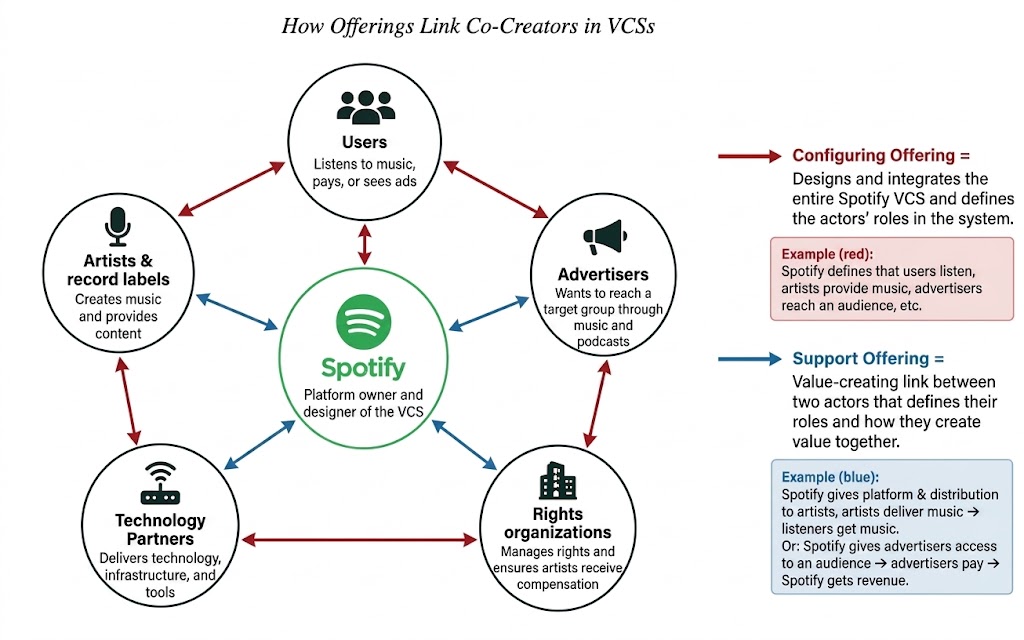
In a Value Creating System (VCS), the core unit of strategy is no longer the product, but the offering.
An offering functions as a script or code that links actors together and organizes their co-creative relationships.
Configuring offerings establish the overarching design and integration of the entire system.
Support offerings manage the specific, day-to-day interactions between any two actors within that wider system.
A successful offering deliberately balances five elements: people, processes, technology, information, and a distinct formula for sharing both work and risk among participants.
Spotify does not merely sell audio files. Its configuring offering designs and integrates the entire streaming ecosystem. It establishes the overarching rules and roles for the network. Spotify defines that Users listen and pay (or see ads), Artists & record labels provide the music, Advertisers participate to reach targeted audiences, Technology Partners deliver the infrastructure, and Rights organizations ensure compensation. It is the deliberate architectural design of offerings that link diverse actors, balance work and risk, and mobilize capabilities across an entire ecosystem.
Part 3:
Building the Network (Actor-Network Theory)
Traditional strategy assumes an organization controls its assets within clear corporate boundaries. In networked, collaborative environments, however, value is co-created across messy ecosystems of customers, suppliers, regulators, and digital infrastructure.
To explain how leaders can organize and mobilize these interdependent systems without direct hierarchical authority, Ramírez and Mannervik draw on Actor–Network Theory (ANT). ANT views social and economic realities as webs of both human actors and non-human elements (such as platforms, data, and protocols) that actively shape behavior.
Within this framework, strategic execution is treated as a continuous process of translation, aligning diverse interests into a cohesive, functioning network through four fluid phases:
Problematization: Defining a central challenge or opportunity in a way that positions the proposed offering (the new network) as an indispensable solution for all target participants.
Intéressement: Deploying incentives, digital tools, and structural mechanisms to weaken competing alliances and build interest among potential actors.
Enrolment: Defining and negotiating the concrete roles, governance, and reciprocal value flows so that each actor commits to their position in the network.
Mobilization: Ensuring the spokespersons and technical interfaces effectively represent and activate their broader constituencies, stabilizing the network so the strategic design becomes an operational reality.
Part 4: Navigating Unpredictable Uncertainty and Scenario Planning
In the traditional strategic planning view, the future is treated like a game of chess. You might not know your opponent's exact next move, but you generally know the board, the pieces, and the rules of the game. Uncertainty is viewed as a predictable, calculable risk based on the expected moves of peers inside your specific industry box. If you are a traditional hotel chain, your primary calculated risk is another hotel chain undercutting your room rates.
In a Value Creating System (VCS), the environment is no longer static. It is characterized as a "TUNA" context: Turbulent, Uncertain, Novel, and Ambiguous. The most significant uncertainties are unpredictable and arise from entirely outside your traditional domain. The threat or opportunity does not come from a known rival, but from shifting societal values or new collaborative technologies. The hotel industry was not disrupted by a better hotel, but by a software platform (Airbnb) altering how people trust strangers in their homes.
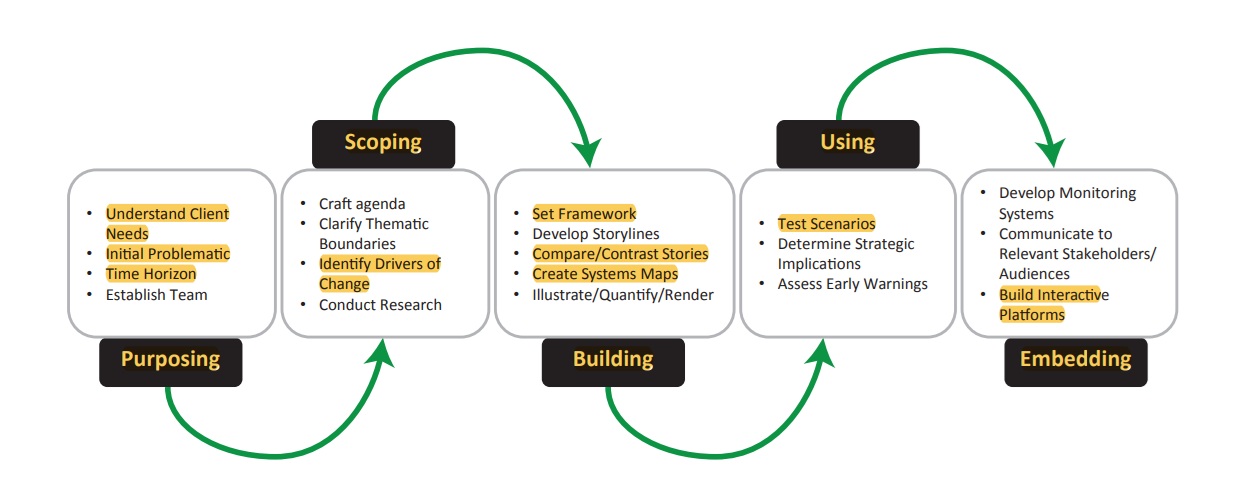
Because you cannot accurately forecast a single, predictable future in a networked world, strategy relies on a continuous, five-phase Scenario Planning loop to stress-test the ecosystem:
Purposing: Strategy begins by establishing your core team, understanding client needs, and defining the initial problematic and time horizon you are planning for.
Scoping: You craft the agenda and clarify thematic boundaries by identifying the broader drivers of change, conducting research on the societal, technological, or political shifts that could alter your landscape.
Building: Instead of betting on one linear forecast, you construct multiple, vastly different plausible storylines. You compare and contrast these future contexts, creating systems maps to illustrate and quantify potential realities.
Using: You drop your configuring offering into these different futures to test its resilience. For example, if a new energy VCS relies heavily on state subsidies to remain viable, you test what happens if a new political reality axes those subsidies overnight. In Sweden, where nuclear power faces shifting political constraints, this phase helps assess potential early warnings and determine the strategic implications of long-term investments.
Embedding: You institutionalize your foresight by developing monitoring systems and interactive platforms. Exploring these scenarios frequently reveals that navigating extreme turbulence requires direct competitors to communicate and collaborate, forming new inter-organizational alliances to decrease the unpredictability that threatens them all.
Strategy is no longer about placing a single bet on a predictable market forecast. If the massive supply chain shocks of recent years have taught us anything, from global pandemics to the war in Ukraine, it is that linear models shatter under real-world pressure. Instead, strategy must use scenario planning to design flexible Value Creating Systems (VCS) capable of absorbing unpredictability and actually thriving in ambiguity. Co-creation is the paradigm we live in today. While smart guys like Peter Thiel advise building a company in a space with literally zero competition, this is simply not a realistic approach for most modern organizations. To succeed in a networked world, we must collaborate with different actors and stakeholders to co-create shared value, moving beyond isolated products to design the best possible interactive "offering".

Big thanks to my amazing project team, Mats, Chaturika, Tove, Solene, and Lukas!